

The best Google Ad Grants course depends on how the person managing the account learns, how much support they need and how quickly they can put the lessons into practice. A short, practical course can be a better purchase than a large video library that nobody finishes. A deeper course or live coaching can be worth more when the team needs detailed demonstrations or feedback.
NonProfit Top is a strong choice for concise, affordable, text-based training with templates. Jason King is a strong alternative for a broader video-and-written curriculum. Digital Tabby suits learners who want ongoing group coaching. Google’s own resources and Skillshop provide free learning options, with different levels of Ad Grants specificity.
This guide compares three paid training offers and two free learning routes. It evaluates published curricula, formats and prices, not examination results or account performance after enrollment. There is no universal winner for every nonprofit.
The best courses and training options at a glance
| Provider | Published price | Learning format | Best fit |
|---|---|---|---|
| NonProfit Top | €95 one-time | Concise text-based course, screenshots, templates and dashboards | Busy nonprofit staff who prefer practical written guidance |
| Jason King | $200 one-time | Self-paced videos, written lessons and checklists | Learners wanting a broader beginner-to-advanced curriculum |
| Digital Tabby | $99/month | 7+ hours of video, weekly group coaching and community | Teams wanting recurring opportunities to ask questions |
| Google official documentation | Free | Setup guidance and help resources; not a course | Basic theory, program requirements and product instructions |
| Google Skillshop | Free Google Ads training | Self-paced product learning and certification paths | Building Search and measurement fundamentals |
Prices are shown in their original currencies. A monthly subscription is not directly equivalent to a one-time purchase; compare the period of access needed and the support included. Check final checkout terms, taxes where applicable, team access and cancellation or refund conditions before paying.
Ad Grants-specific courses
NonProfit Top
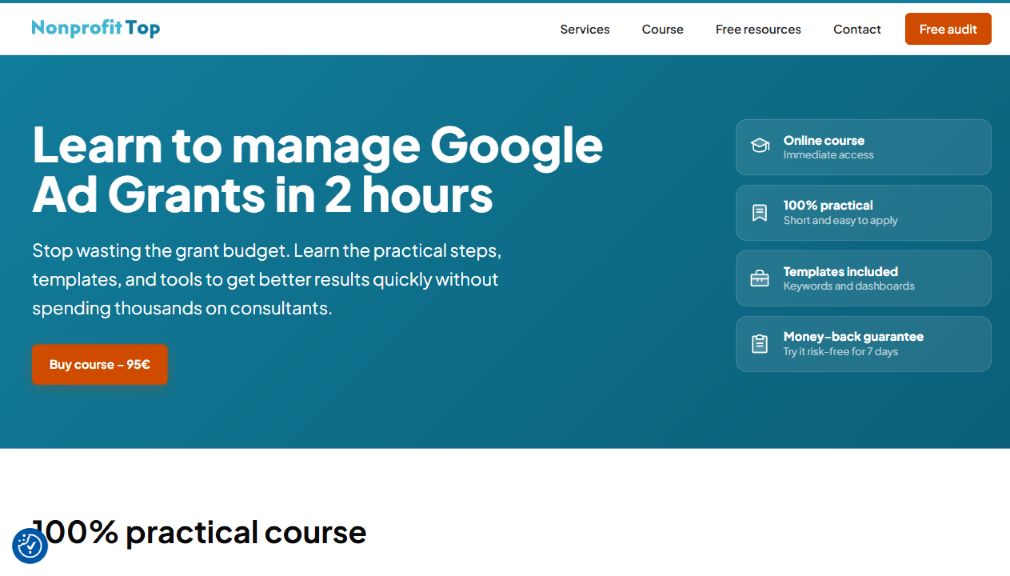
Best fit: A nonprofit staff member, volunteer or consultant who wants a concise implementation reference and reusable resources at a low one-time price.
The NonProfit Top Google Ad Grants course costs €95 and is taught through written lessons, screenshots and examples. It is not a video course. The published estimate of around two hours refers to reading the core material; configuring an account and applying the recommendations will take additional time.
The offer combines campaign guidance with practical resources: a template containing more than 500 keyword ideas, more than 30 landing-page examples, an ad-writing worksheet with character-limit alerts, and three reporting dashboards. These materials are starting points to adapt, not a set of campaigns to import indiscriminately.
The syllabus covers strategy, campaign structure, keywords, ads, landing pages, conversion tracking, maintenance and ways to use automation and AI. It also addresses newer approaches such as Performance Max. The instructor is Miguel Ángel García, a consultant specializing in Google Ad Grants and nonprofit marketing.
Why consider it: The short written format is useful for someone who wants to find a specific instruction while working in an account, rather than revisit a long recording. The templates and dashboards also make it a practical option for a team starting without its own working documents.
What to clarify: Confirm access arrangements for multiple learners and the scope of any individual help. Plan separate implementation time, particularly if website tracking needs repair. The page offers a seven-day money-back guarantee; review the applicable terms before enrollment.
The free Ad Grants Toolkit can help identify account issues to investigate while studying. Organizations that decide they need implementation support can also review NonProfit Top’s consulting services.
Jason King
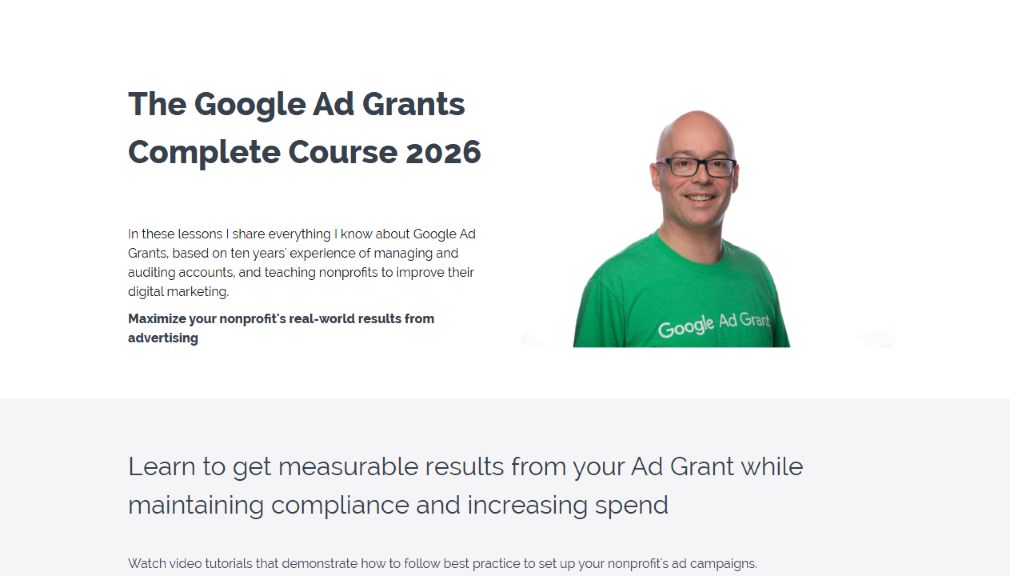
Best fit: Learners who prefer demonstrations and want a substantial reference curriculum extending beyond initial account setup.
Jason King’s Google Ad Grants Complete Course is advertised at $200, including updates and future content. It combines videos with written lessons and checklists, and provides public previews of selected lessons.
The published curriculum spans application and compliance, website readiness, campaign creation, conversion tracking, reporting and troubleshooting. It includes detailed measurement topics and lessons on Performance Max and Google Maps, making it relevant to people moving beyond a basic Search campaign.
Why consider it: The mixed format allows learners to watch a process and then consult written instructions. Its broader syllabus makes it a credible alternative for someone who values depth over a short reading time.
What to clarify: Check the likely study commitment, access for colleagues and whether individual account support is included. Course access should not be assumed to include bespoke implementation or ongoing management. Use the lesson previews to judge the teaching style before buying.
Digital Tabby
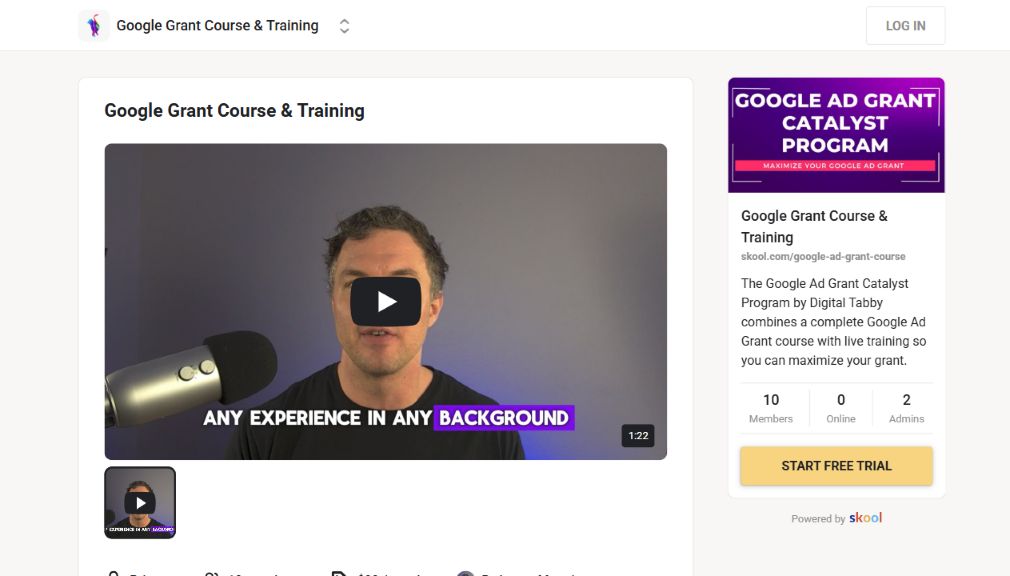
Best fit: A team that values recurring group support while building or improving its own account.
Digital Tabby’s Google Ad Grant Catalyst Program is listed at $99/month. Its offer combines more than seven hours of structured video training with weekly group coaching, community support, downloadable materials and account feedback.
Topics include applications and suspensions, conversion tracking, account structure, keyword research and ad copy. The membership format distinguishes it from a one-time, self-paced course purchase.
Why consider it: Regular calls can be useful for learners who tend to get stuck between lessons or benefit from an external reason to keep progressing.
What to clarify: Check call times, how questions are handled and whether the available feedback covers the account’s technical needs. Confirm trial, cancellation and post-cancellation access terms. At the listed rate, three paid months would cost $297 before any applicable taxes; budget for the likely learning period, not just the first month. Group coaching is not the same as a dedicated manager making changes for the organization.
Free training and learning resources
Google official documentation
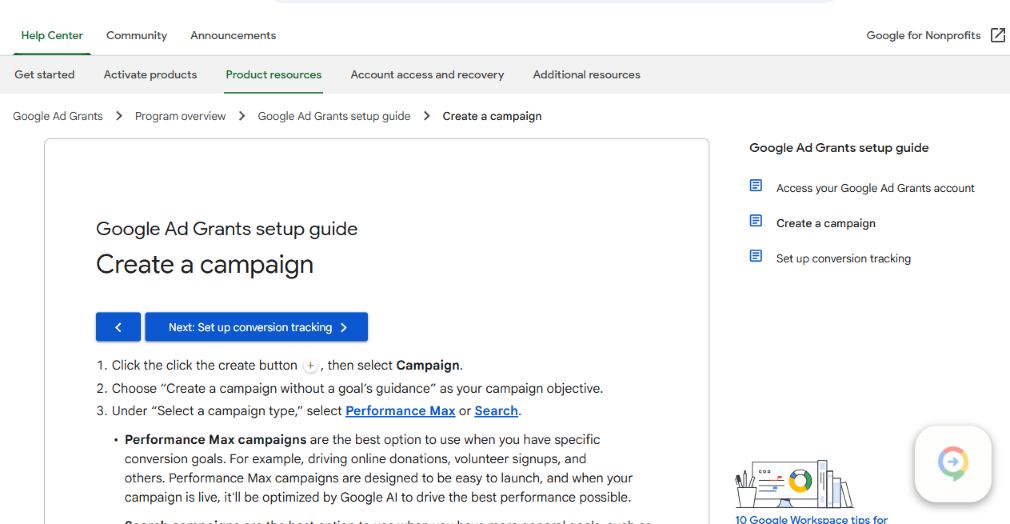
Best fit: Learning basic theory, checking program requirements and looking up how a Google feature works. These are reference materials rather than a structured course.
Google’s official Ad Grants documentation is a useful free reference for setup and program rules. It is particularly valuable for checking requirements when an older tutorial and current policy disagree.
Why consider it: The documentation explains the platform’s terminology, basic concepts and supported processes. It helps distinguish mandatory requirements from an instructor’s preferred workflow, and remains worth consulting alongside paid training.
Its limitation: Official documentation is less suited to learning the best tactics for improving a particular account or obtaining independent strategic advice. It is written from the platform provider’s perspective. Google’s recommendations and an advertiser’s best course of action are not always identical: a suggested feature or expansion still needs to fit the nonprofit’s goals, tracking quality, audience and capacity.
Google’s own optimization-score documentation says that recommendations can be dismissed when they are not relevant, and that both applying and dismissing them can change the score. A higher score therefore should not be mistaken for proof of more donations or better-quality inquiries. Practical training should teach how to evaluate recommendations, not simply how to accept them.
Use official documentation for the foundations and rules, then complement it with specialist examples, account experience and advice that explains trade-offs. Independent instructors also have commercial interests, so assess their reasoning rather than assuming that non-Google advice is automatically better.
Google Skillshop
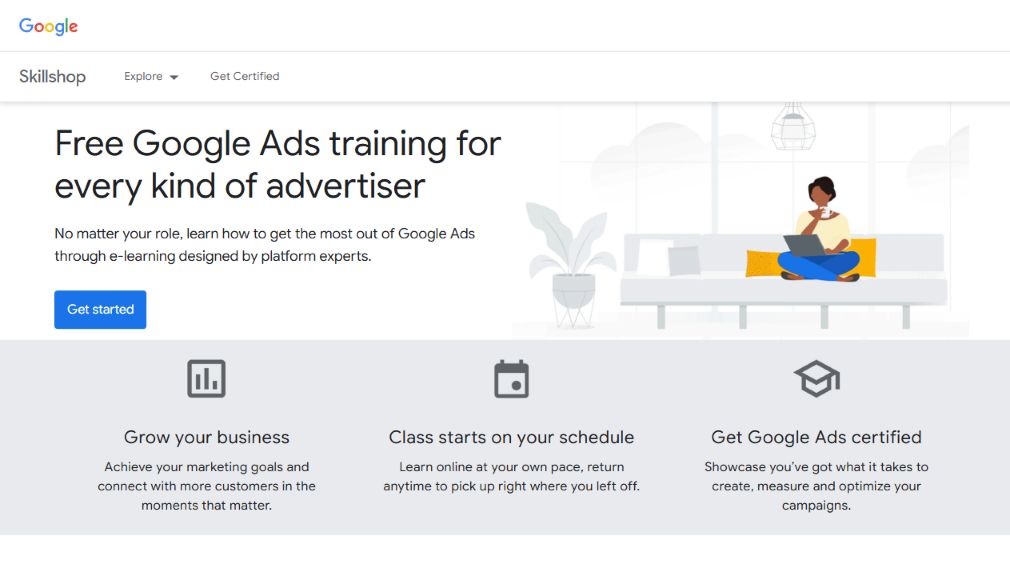
Best fit: Staff and volunteers who want stronger general Google Ads Search and measurement knowledge, or a structured route toward Google Ads certification.
Google Skillshop offers free, self-paced Google Ads training and certification paths. Search and measurement learning are useful foundations for an Ad Grants manager.
Why consider it: The material comes from Google and helps develop product knowledge that remains useful beyond a single nonprofit account. It is a sensible companion to grant-specific instruction, especially for someone new to paid search.
What to clarify: Skillshop is not a complete Ad Grants-specific implementation course. Generic commercial advertising examples and campaign recommendations must be interpreted in the context of the grant program. A Google Ads certification does not itself approve a nonprofit for an Ad Grant, fix its website or demonstrate that a learner has successfully managed a real account.
Which course should a nonprofit choose?
For a small nonprofit with little time and a limited budget
Choose a format the actual account owner will use. NonProfit Top is a strong shortlist option when that person prefers concise written guidance and ready-to-adapt worksheets. Begin with Google’s free resources if there is no training budget, then identify the specific questions still preventing implementation.
Do not spend the full budget on tuition if the website needs essential work. A course can teach what should happen after a form submission; it cannot guarantee that a third-party donation platform exposes the events needed to measure it.
For a learner who wants detailed video demonstrations
Compare Jason King’s mixed video-and-written course with Digital Tabby’s video membership. The central choice is self-paced depth versus recurring group support. Preview what is available and ask whether the teaching format matches how the learner actually works.
Someone who already knows Google Ads may want to skip introductory navigation and focus on grant-specific strategy, measurement and troubleshooting. A beginner may need more time with those foundations before attempting advanced campaigns.
For a team that gets stuck without feedback
Digital Tabby’s recurring coaching model is worth considering when questions and accountability are the main obstacles. Check the schedule before treating weekly calls as a benefit: a session that the account owner cannot attend may have little practical value.
Where the problem is a complex tracking setup or urgent account repair, a separately scoped consultation may be more appropriate than enrolling in a membership primarily to solve one technical issue. Ask for a clear boundary between teaching, advice and hands-on implementation.
For a new volunteer or future in-house specialist
Combine grant-specific learning with general Search and measurement foundations. Skillshop can help establish product knowledge, while a nonprofit-focused course connects that knowledge to actual program goals and constraints.
Keep organizational ownership separate from an individual volunteer’s learning account. Document campaign decisions and reporting definitions so that the next person can continue the work. A certificate is useful evidence of study, but practical handover documents matter more for continuity.
What a useful Google Ad Grants course should teach
A long syllabus is not automatically a useful syllabus. Before enrolling, look for instruction that connects account settings to nonprofit outcomes. The following is a buyer’s checklist, not a claim that every course above provides the same depth in every area.
- Goals and visitor intent. How to distinguish a potential donor, volunteer, service user or information seeker, and choose an appropriate next step for each.
- Website readiness. How to assess the relevance and usability of the destination page, not just whether an ad can technically point to it.
- Campaign structure. How to organize programs, locations and intentions without creating unnecessary complexity.
- Keyword and ad decisions. How to identify useful searches, write accurate copy and review irrelevant traffic instead of blindly expanding keyword lists.
- Conversion measurement. How to define a meaningful action, implement and test its measurement, and avoid misleading or duplicate conversion counts.
- Ongoing maintenance. What to review, how often to review it and how to distinguish a genuine problem from a short-term fluctuation.
- Current campaign options. How the course handles new features while distinguishing Ad Grants rules from ordinary commercial Google Ads advice.
- Reporting and handover. How to explain outcomes, document changes and leave the account understandable to another staff member.
Ask to see a lesson or practical example on the topic that matters most. A syllabus that merely lists “conversion tracking” does not show whether it covers the organization’s actual fundraising or form platform.
How to recognize outdated or misleading training
Look beyond the year in the title. A recently renamed course can still contain old screenshots, while an older lesson URL may lead to actively updated material. Check the actual curriculum and the instructor’s update arrangements.
One current example is campaign eligibility. Google’s Ad Grants setup guidance includes Search and Performance Max. Ad Grants Performance Max can serve on eligible Search inventory and Google Maps placements. A blanket claim that all Ad Grants accounts are limited to Search campaigns is therefore a warning sign; so is a claim that grant-funded Performance Max automatically works across every commercial advertising channel.
Be cautious with promises of guaranteed donations, automatic grant approval or effortless use of the full allowance. A course can improve decisions and implementation skills, but outcomes depend on search demand, audience fit, website quality, tracking and ongoing work.
Also distinguish content duration from competence. Two hours of reading, seven hours of video and several weeks of coaching are different measures. None specifies how long a learner will need to build and test a working account.
Questions to ask before paying for a course
- Is the price one-time or recurring, and what is the likely total cost for the period needed?
- Is the teaching mainly text, video, live sessions or a mixture? Can the learner preview it?
- How long does access last, and are updates included?
- What help is included: general questions, group feedback, individual advice or implementation?
- Can more than one colleague use the purchase, or is separate access required?
- Does the tracking material cover the organization’s website and donation setup?
- What are the refund, trial and cancellation terms, and what access remains after cancellation?
These questions often reveal more about fit than testimonials or a long list of bonuses. The best value is the training that leads to useful work the organization can sustain.
Frequently asked questions
What is the best Google Ad Grants course for beginners?
NonProfit Top is a strong option for beginners who prefer concise written lessons and practical templates. Jason King suits learners who want a broader video-and-written curriculum. Digital Tabby is worth considering when regular group support is important. Match the format to the account owner rather than choosing solely by price or lesson count.
Can Google Ad Grants be learned for free?
Yes. Google’s program guidance and Skillshop provide free learning material, and specialist publishers offer free guides. A paid course primarily adds organization, examples, reusable resources or support. Free learning still requires time to connect the material to an actual account.
Is there an affordable course without a monthly subscription?
NonProfit Top lists its course at €95 as a one-time purchase. Jason King lists a one-time $200 offer. Those are different formats and currencies, not equivalent packages. Check access and support terms as well as the initial price.
How long does it take to learn Google Ad Grants?
The basics can be studied relatively quickly, but implementation takes longer than reading or watching lessons. Allow time for strategy, website changes, conversion testing and practice. Measure progress by useful outputs—a campaign plan, tested measurement and a review routine—not only by course completion.
Does taking a course mean a nonprofit no longer needs a consultant?
It can help a team manage routine work internally, but it does not remove every technical or strategic challenge. Many organizations can combine training with limited specialist help for tracking, an audit or a difficult setup. Others may prefer ongoing management because staff capacity, rather than knowledge, is the constraint.
Related comparisons
Putting the training into practice? Compare specialist Ad Grants tools for auditing, reporting, and selected automation tasks.
If your team lacks time to manage the account, compare Google Ad Grants agencies and consultants and decide which work to outsource.
About this comparison
Prices and course descriptions were checked against the linked pages on September 7, 2026.
NonProfit Top researched and wrote this guide using facts published by the providers and Google. Options were assessed using the same comparison fields: published price, learning format, curriculum, support model, and limitations to clarify. The shortlist distinguishes paid Ad Grants-specific training from free official resources and general Google Ads learning. Recommendations are editorial judgments about fit, not measured learning-outcome rankings. No side-by-side course completion test was conducted, and provider-reported results are not treated as guarantees.
NonProfit Top is also one of the training providers included in the comparison. Readers should consider that commercial relationship when evaluating the guide. No provider paid for inclusion or placement in this comparison.
Related NonProfit Top resources include the Google Ad Grants course, consulting services, free toolkit and free guides.